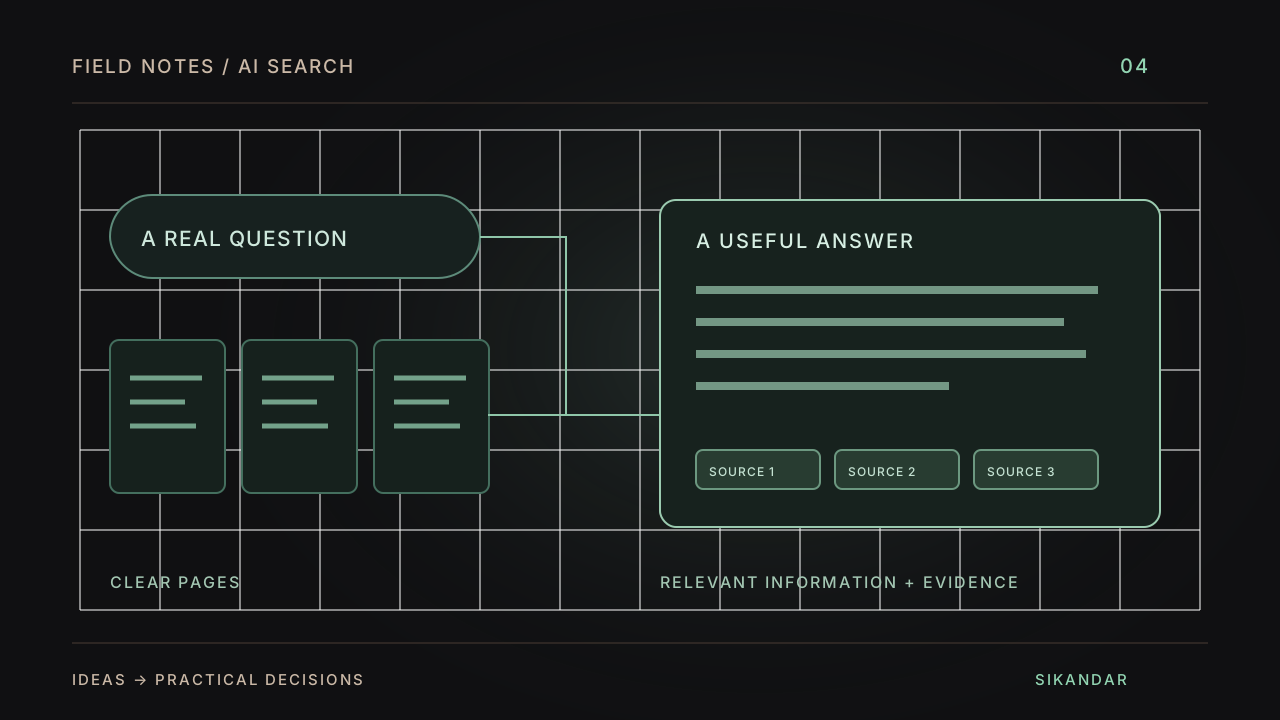
Publish specific answers backed by useful evidence, keep the pages accessible to search engines, and make the next step clear for a real visitor. No special file can guarantee an AI recommendation.
Why GEO is part of the current website conversation
Google published a dedicated resource on optimizing for generative AI search in May 2026, including discussion of common AEO and GEO misconceptions. Its documentation for AI Overviews and AI Mode still says established SEO practices apply, with no additional technical requirements for those features. That is a more useful starting point than a checklist promising guaranteed inclusion.
This guidance is specific to Google. Other search and assistant products can use different discovery systems and controls. It would be misleading to treat one provider's documentation as a universal ranking formula.
Write the page a prospective customer actually needs
A page titled ‘Our solutions’ asks the visitor to work out what is being sold. A focused page can explain the service, the situations it suits, the information needed to start and the boundaries of the offer. Specificity helps a reader decide whether to continue.
Consider an illustrative search for an interactive exhibition experience. Useful questions include how visitors join, what hardware is needed, which languages the interface supports and what happens between sessions. Answer the questions the service genuinely addresses. Repeating the phrase ‘best interactive experience’ does not answer any of them.
Make evidence easy to distinguish from promotion
Explain where factual claims come from. Use named sources for external research and describe the scope of your own evidence accurately. A design image demonstrates a visual decision; a measured outcome requires a measurement and enough context to interpret it.
For an advice article, add something a reader can use: a decision framework, a worked hypothetical example, a meaningful comparison or a checklist that exposes a common mistake. A summary of the same public announcements everyone else has read gives a visitor little reason to choose your page.
Source: Google: guidance on quality and generative AI content
Check the technical foundation without chasing a magic format
Google's AI-feature guidance highlights crawl access, internal links, text that is available on the page, and structured data that agrees with visible content. It also says a page must be indexed and eligible for a search snippet to appear as a supporting link. Meeting those conditions does not guarantee that Google will select it.
For a practical review, open a service page directly rather than through the homepage. Check that its title is meaningful, its main explanation is present, and its contact link works. Confirm that important content is not available only inside an image. These checks serve visitors as well as discovery.
Source: Google: eligibility and technical requirements for AI features
Give each article a useful relationship to a service
An article can answer a question earlier in the buying journey than a service page. Someone researching whether AI video can support a campaign may not yet be ready to hire an editor. Help them understand the production choices first, then offer a relevant next step.
Keep that connection proportionate. One contextual service link is often clearer than interrupting every section with a sales pitch. Avoid creating many near-identical pages for slightly different keywords or cities. Expand the library when a new article has a distinct question and a worthwhile answer.
- Name the reader and the decision the article supports.
- Check current facts against identifiable sources.
- Add an explanation or tool the reader can actually use.
- Link to the service that follows naturally from the topic.
- Review the article when its underlying information changes.
Measure discovery and enquiries separately
Track which pages attract search impressions, which queries lead to visits and whether those visits produce relevant enquiries. A source mention in an AI answer and a paying customer are different outcomes. Decide which signals you can reliably observe before setting targets.
The work is iterative: improve an unclear page, publish a useful answer, inspect the evidence and refine the next topic. A stronger site gives search systems more worthwhile material to discover while giving people a better reason to contact you.