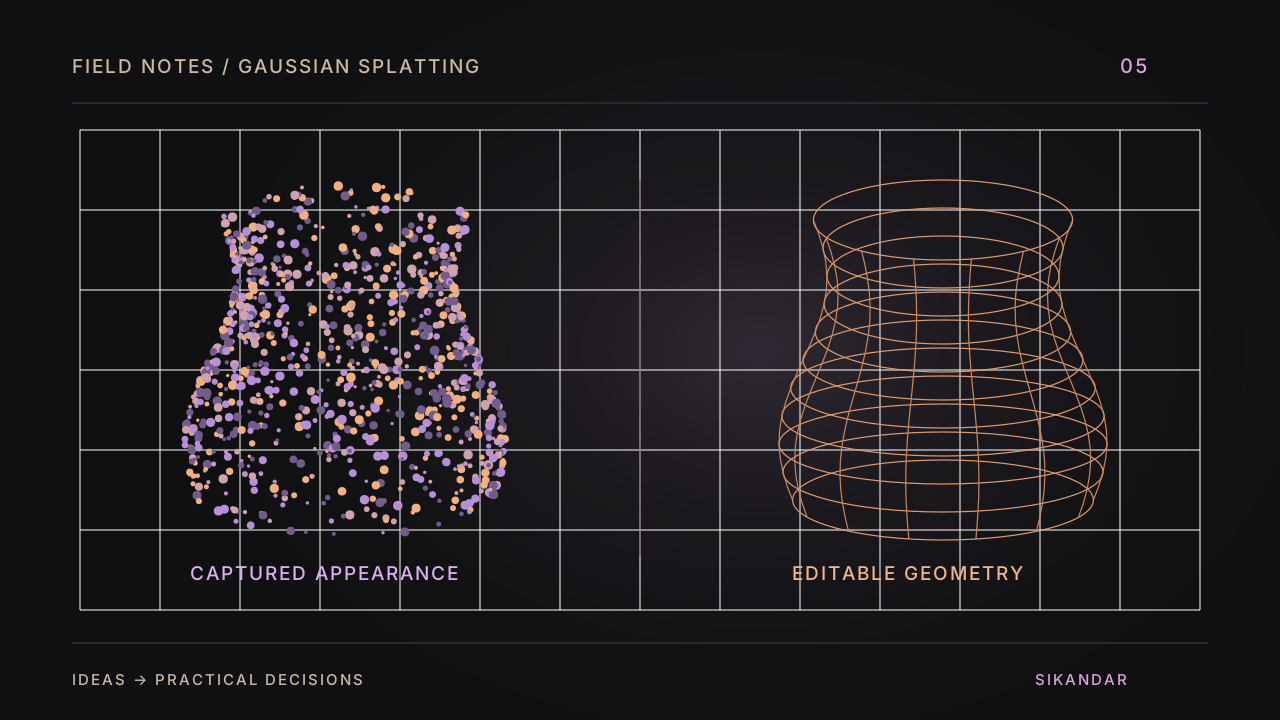
Choose the representation around the job. Capture can communicate the appearance of an existing scene; editable geometry gives you direct control over form. Validate the intended viewer and device before scaling up.
Why Gaussian splatting is a timely subject for the web
The technology is moving through practical publishing and viewing tools, not just research demonstrations. PlayCanvas released a rebuilt SuperSplat editor using WebGPU in September 2026, followed by an October update with changes to scene discovery and XR viewing. These releases make it worth asking how a captured 3D scene could fit into a website or exhibition experience.
They do not establish that every scene will load quickly on every device. A commissioning decision still needs a representative capture, a delivery format and a test on the hardware the audience is likely to use.
What is Gaussian splatting?
In the original 3D Gaussian Splatting method, a scene is represented with many optimized 3D Gaussians rather than a conventional surface mesh. The representation is fitted using captured views and rendered to show the scene from new viewpoints. The 2023 research paper introduced an efficient approach to that process.
A useful nontechnical picture is a collection of overlapping, oriented samples of a scene's appearance. This is only an analogy; a splat is not simply a photograph floating in space. What matters to a buyer is the relationship between the captured material, the views that look convincing and the way the result will be presented.
When a traditional model is the clearer choice
If the brief requires changing dimensions, designing a new object, preparing controlled material variants or handing over editable geometry, ask specifically for those deliverables. A visually convincing capture should not be assumed to include a clean, reusable model with the structure those tasks need.
Consider a hypothetical showroom. Letting a visitor explore the existing room is one goal. Replacing its fixtures, changing the product layout and producing several proposed designs is another. The second brief calls for explicit control over the objects and their relationships. A mixture of capture and modeled elements may be worth investigating, but the integration needs its own test.
Review a capture along the visitor's intended route
Do not judge the result from a single attractive starting view. Decide where visitors can move and which details they should inspect. Review that path for incomplete areas, distracting artifacts and viewpoints that reveal gaps. If the presentation is guided, make the path deliberate rather than suggesting unrestricted access.
The capture plan should follow the intended experience. List the spaces or objects that matter, the access available for capture and what might move during the session. Ask for a small representative sample before commissioning a large environment. It is easier to change the plan before the full capture has been produced.
Design the page around the 3D experience
A viewer still needs an invitation, understandable controls and a useful exit. Tell people whether they can drag, walk or switch viewpoints. Keep important service information and contact details available as ordinary page content so the page remains useful if the 3D view cannot run.
Agree a performance budget for the intended devices and connection conditions. Check the first visible result, the wait before interaction and the behavior when returning to the page. A lightweight still preview can explain what will open before asking the visitor to load the full experience. These are presentation decisions, not just file-export settings.
- Existing scene or a design that must be changed?
- Guided camera route or free exploration?
- Final images, a browser viewer or editable source assets?
- Which mobile, desktop or headset devices matter?
- What should visitors see if the viewer is unavailable?
- Who owns capture, cleanup, hosting and later updates?
Commission a sample that answers a real question
A useful pilot might cover one room, one object or one short visitor path. Write down what it must demonstrate: convincing views, readable details, manageable loading and a clear interaction. Compare the result with the alternatives against those same goals.
The objective is to select an appropriate production method, not to use a technique because it is new. A controlled render, a captured scene and an interactive model can all be useful when their strengths match what the audience needs to understand.