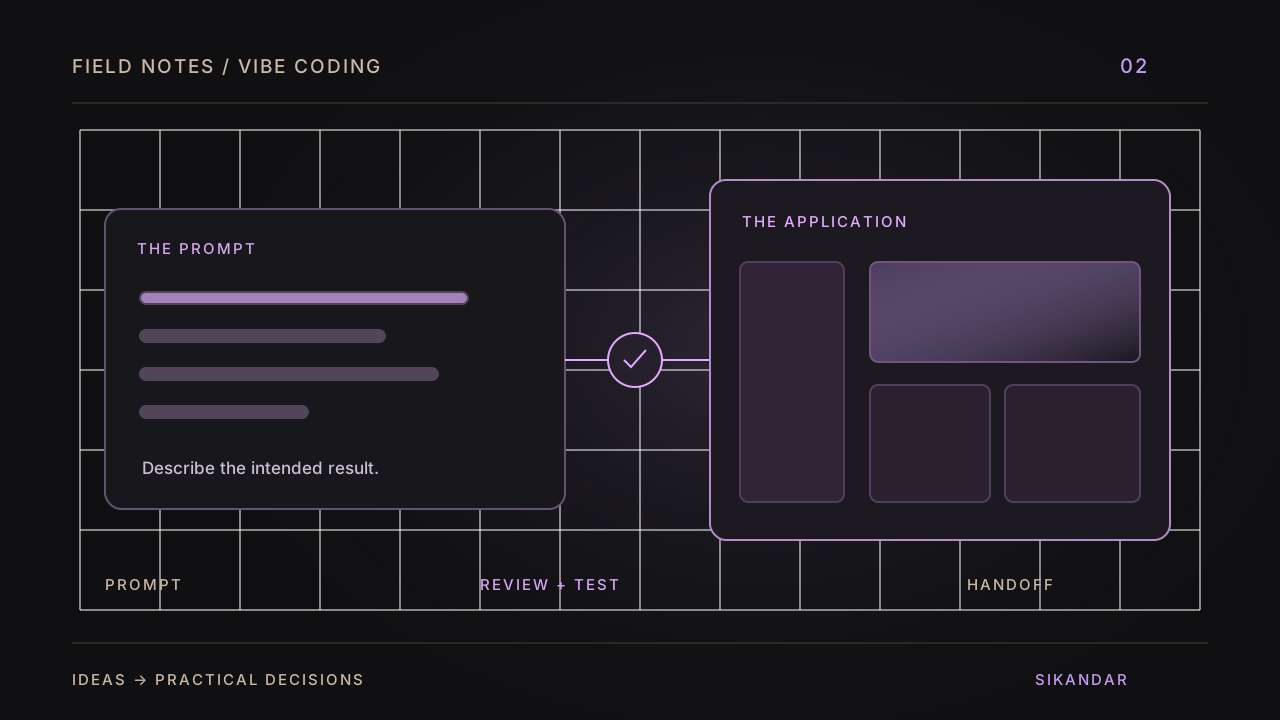
Use AI to accelerate implementation, then judge the result by its behavior, maintainability and handoff. A persuasive demo is a starting point for review.
Why the discussion has moved beyond generating code
AI coding remains a prominent part of the developer conversation. Stack Overflow's 2026 survey includes dedicated results for coding assistants, agents and trust in their output. In October, Anthropic also described redesigning its source-control infrastructure to handle a much larger flow of agent-produced changes. These are signals of active adoption; neither is a guarantee that an individual generated application is dependable.
The useful lesson for a founder or business owner is to ask about the delivery process as well as the tool. Generating more code creates more material to understand, verify and maintain.
Source: Stack Overflow: 2026 AI survey results
Source: Anthropic: Redesigning source control, 13 October 2026
What does vibe coding mean for a buyer?
The term is commonly used for building software through natural-language requests to AI tools. It can describe anything from a quick experiment to a heavily reviewed implementation, so the label alone tells a buyer very little about the finished work.
Ask to see one complete journey. For an illustrative quotation tool, that might mean creating a customer, adding line items, saving the quotation, reopening it and exporting a usable document. A screen that calculates a total is only one part of that journey. The definition of done should include the parts that are less visible during a demo.
Check what happens to data and access
Find out where information is stored, who owns the account and how a user gets it back. A browser-only prototype may be suitable for a personal experiment but unsuitable for a team that needs shared records. Neither approach is inherently wrong; the choice needs to match the brief.
Permissions deserve their own review. Hiding an administrative button does not establish a server-side access rule. Ask how the system responds when an unauthorized user requests the underlying action directly, and how access is removed when somebody leaves. Payment, email and other external services also need named owners and documented configuration.
Try the awkward cases before adding more features
Use the application with a missing field, a long name, a duplicate record and a slow connection. Open it on a phone. Refresh halfway through a task. Attempt to retry an action after a timeout. The goal is to discover whether the software explains its state and helps the user recover.
A useful acceptance checklist describes observable outcomes rather than internal implementation details. For the quotation example: saved work survives a refresh, duplicate submission does not create two quotations, validation identifies the right field, and export preserves the agreed information. These checks can be reviewed regardless of who or what produced the code.
Ownership and maintenance belong in the first conversation
Request the source code, dependency information, setup instructions and a description of the deployment process when those are part of the agreed deliverables. Know which services require an ongoing subscription and which features stop if a third-party integration is unavailable.
The person accepting the software should also understand the support arrangement. Who investigates an error after launch? How are changes reviewed and released? A small, well-documented application can be a better fit than a feature-heavy system nobody is comfortable maintaining.
- One complete workflow with written acceptance criteria.
- A clear data-storage and access model.
- Review of normal use, failures and recovery.
- Account ownership and deployment instructions.
- An agreed scope for maintenance and future changes.
Use the speed to explore, then make deliberate decisions
Fast prototyping is valuable because it makes an idea easier to discuss. Use that advantage to compare flows, remove unnecessary steps and discover what people actually need. Avoid treating every generated feature as something that must ship.
The strongest brief focuses on an outcome: fewer repeated steps, a clearer review process or a more usable customer journey. AI-assisted implementation can support that goal, but the quality of the result still needs evidence from the application itself.